آرشیو بلاگ
آخرین نظرات

امیرحسین قلیزاده
در فرش شناسی با خانم دکتر جعفری
امیر مسعود لباف
در فرش شناسی با خانم دکتر جعفری
مهرداد طاهری
در لچک ترنج پر تکرار ترین نقشه در میان فرش های...
جستجوی بلاگ
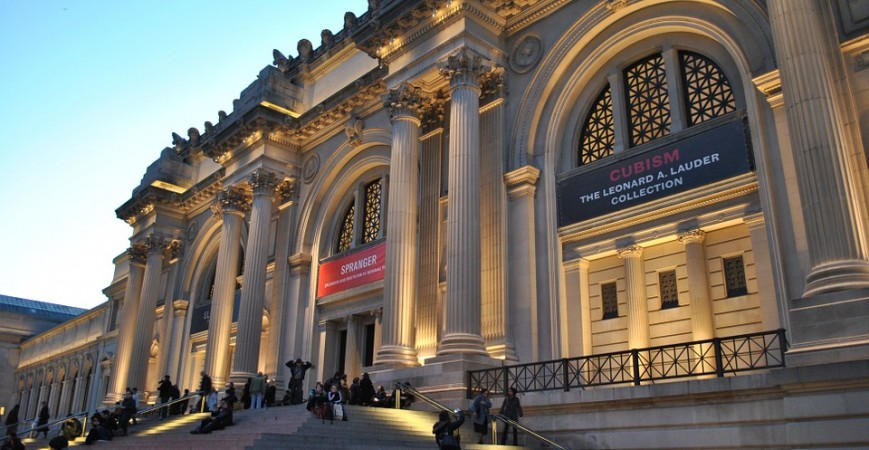
Oriental Rugs at the Metropolitan Museum of Art
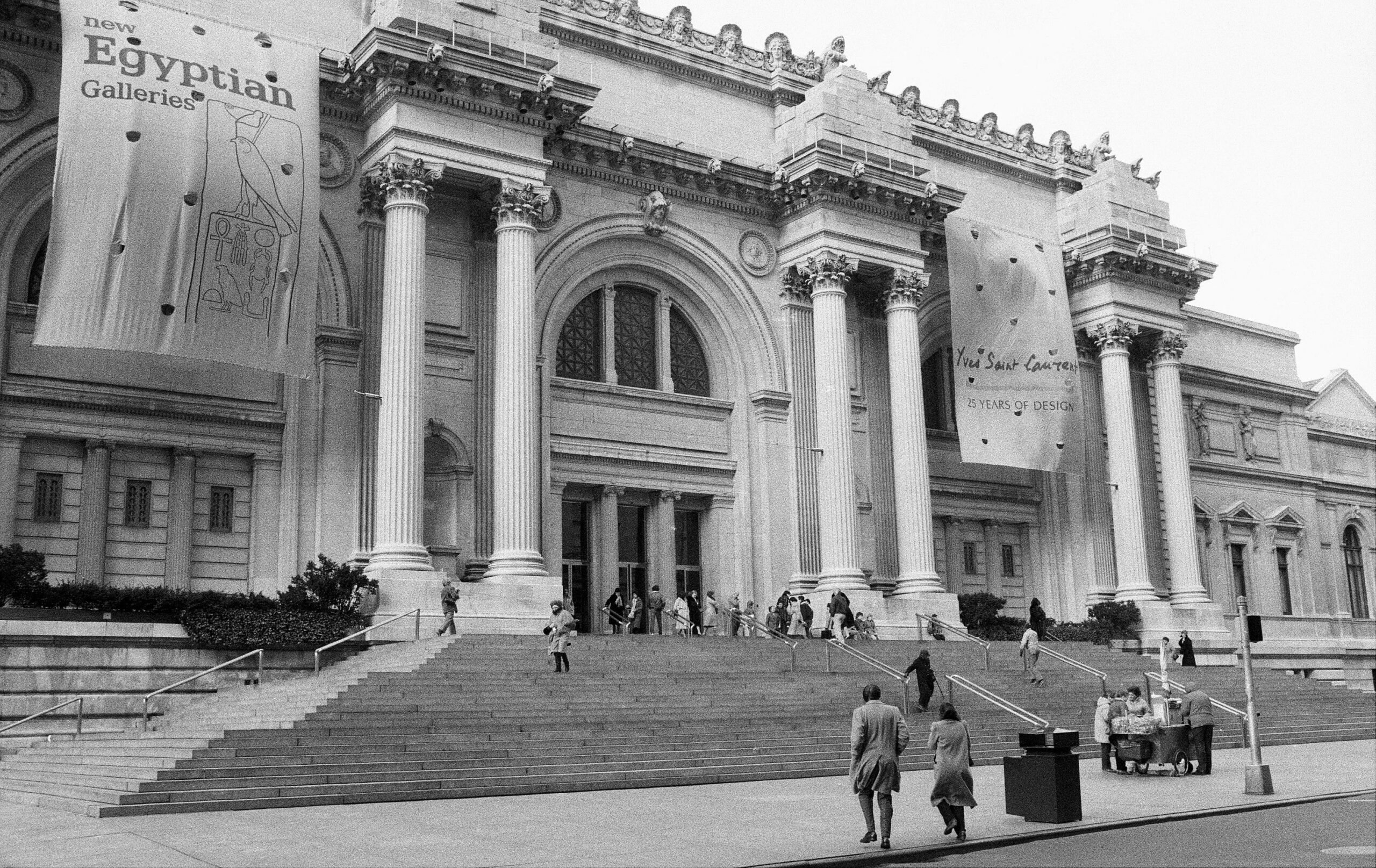
The Formation of the Metropolitan Museum: From a Cultural Idea to One of the World’s Greatest Museums
In the early years of the museum’s activity, works related to the Islamic world and Iran were not yet displayed according to the precise classifications used today. Many of these objects were presented alongside decorative items, textiles, glassware, ceramics, and applied arts. At that time, the museum approach to Islamic art was still taking shape, and terminology was not used with the same precision as it is today.
For example, in some old museum documents and photographs, titles such as “Persian Room” were used. However, this title did not always refer exclusively to works connected to present-day Iran. In museum language of that period, the term “Persian” was sometimes used to refer more broadly to Islamic-period art or Oriental art. Similarly, terms such as “Assyrian” were used to distinguish ancient Near Eastern works from those of the Islamic period. This shows that the classification of Oriental, Persian, and Islamic arts in the early twentieth century was still undergoing a process of development.
Nevertheless, what is important is that Iranian and Islamic art, even at that time, was considered an attractive and display-worthy subject for the Metropolitan Museum. Carpets, tiles, ceramics, textiles, and metalworks from Iran and the Islamic world gradually found their place in the museum’s galleries and became a serious part of the broader narrative of world art.
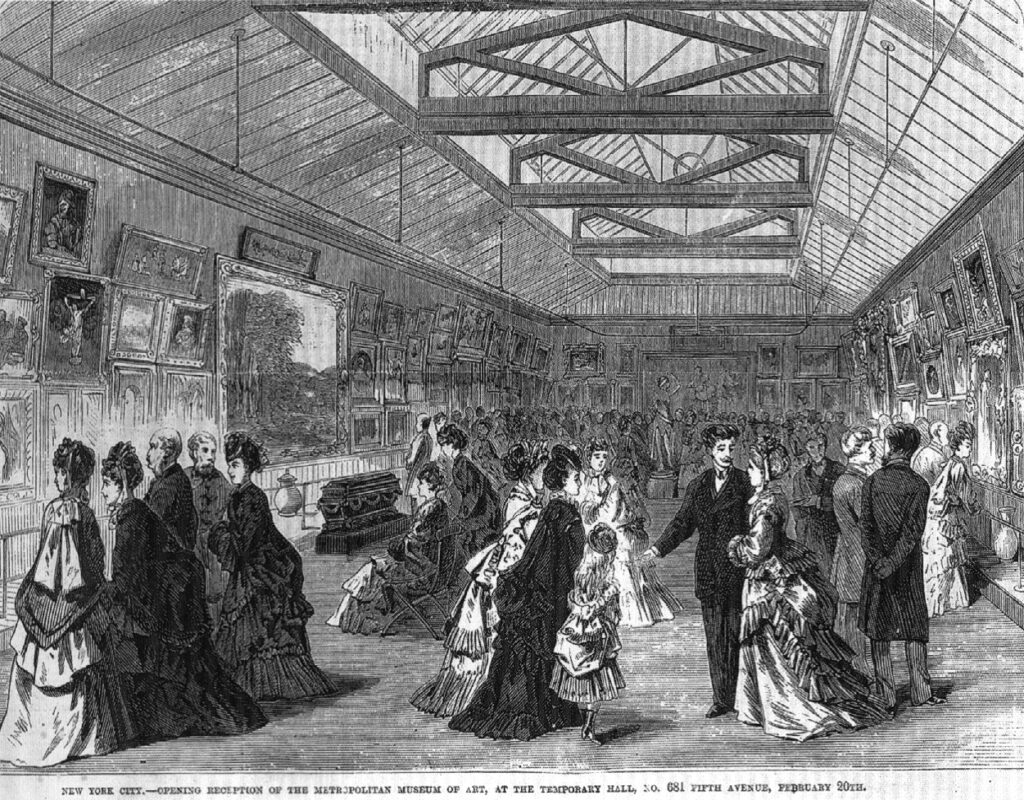
Opening Reception in the Picture Gallery at 681 Fifth Avenue, New York, on February 20, 1872. This image was published as a wood engraving in Frank Leslie’s Weekly on March 9, 1872.
The Place of Islamic and Persian Art at the Metropolitan Museum
One of the most significant moments in the Metropolitan Museum’s engagement with carpets was the exhibition “Early Oriental Rugs” held in 1910. This exhibition was among the museum’s earliest serious initiatives dedicated to Oriental carpets and Islamic art. It featured dozens of Oriental rugs drawn from both the museum’s own collection and private collectors, and an illustrated catalog was produced to accompany the exhibition.
The importance of such an exhibition lay in the way it transformed the perception of carpets. Rather than being viewed solely as household furnishings, commercial goods, or decorative objects, carpets were presented within the context of scholarship, art history, and museum studies. When a handwoven rug is hung on the wall of a museum or displayed in a specialized gallery, it conveys a clear message: it is not merely an object of everyday use, but a work that embodies history, artistic achievement, technical mastery, color theory, design, and cultural heritage.
During this period, many Western audiences encountered Persian, Turkish, Caucasian, Indian, and Central Asian carpets for the first time not as commercial products, but as genuine works of art. This shift in perception played a crucial role in enhancing the international prestige and recognition of Oriental carpets and establishing them as an important part of the world’s artistic and cultural heritage.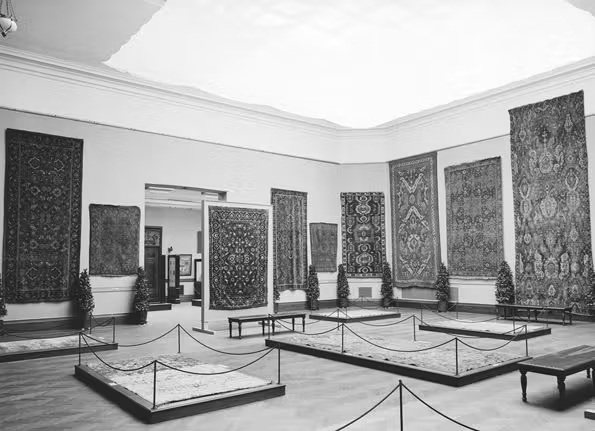
Gallery E-1, November 7, 1910. This exhibition, held under the title “Early Oriental Rugs,” was the Metropolitan Museum’s first exhibition specifically devoted to a subject within the field of Islamic art. The organization and arrangement of the exhibition, as well as the preparation of its illustrated
catalogue, were carried out by Wilhelm Valentiner, the museum’s curator of decorative arts.
The 1910 Exhibition of Oriental Rugs: A Significant Milestone in Carpet History
During the early twentieth century, galleries dedicated to Islamic and Oriental art at the Metropolitan Museum gradually expanded. One of the most well-known images from this period is a 1912 postcard depicting Gallery E-14, a space then known as the “Persian Room.” This image demonstrates that works associated with Iran and the Islamic world already enjoyed a notable presence within the museum.
As mentioned earlier, the term “Persian” during that era sometimes carried a broader meaning than the boundaries of present-day Iran. Nevertheless, this fact is significant because it illustrates how the name of Iran, Persian art, and Persian aesthetics were deeply intertwined with the Western museum perception of Islamic and Oriental art from an early stage.
Over time, these galleries became increasingly specialized. Objects were no longer displayed merely as decorative pieces or scattered exhibits. Instead, they were organized according to historical periods, geographic regions, artistic styles, and cultural contexts. This transformation reflected the growing academic understanding of Islamic art history and the museum’s effort to present a more accurate narrative of diverse civilizations.
Persian Rooms and Galleries: From the “Persian Room” to the Islamic Art Galleries
As the Metropolitan Museum expanded its collections and scholarship, its approach to exhibiting Islamic and Persian art evolved as well. Early spaces such as the “Persian Room” represented an important first step in introducing visitors to the artistic traditions of Iran and the broader Islamic world. These galleries offered Western audiences an opportunity to encounter carpets, ceramics, metalwork, textiles, and architectural elements from regions that were often little understood outside scholarly circles.
Over the following decades, the museum refined its presentation methods and curatorial practices. Exhibitions became more historically grounded, allowing visitors to understand artworks within their cultural and historical contexts rather than simply appreciating them as exotic decorative objects. This shift played an important role in establishing Persian and Islamic art as an essential component of global art history.
The 1926 Concert: When Classical Music Was Performed Among Oriental Carpets
One of the most remarkable and poetic moments in the history of carpet exhibitions at the Metropolitan Museum occurred in 1926. That year, Gallery D-3, located near the balcony of the museum’s Great Hall, was dedicated to the display of Oriental carpets. Rugs from Iran, Turkey, Spain, and other regions were mounted side by side along the gallery walls.
According to museum records, this gallery was also used during the museum’s free symphonic concerts and frequently accommodated overflow audiences. A report published in The New York Times in January 1926 noted that more than 7,800 people attended a program featuring works by composers such as Beethoven, Bach, Tchaikovsky, Brahms, Strauss, Saint-Saëns, and Smetana.
The image is a captivating one: thousands of visitors gathered in one of the world’s most prestigious museums, surrounded by historic Oriental carpets while listening to classical music. It demonstrates that carpets within the museum were not merely objects to be viewed; they formed part of a broader cultural experience, contributing to artistic atmosphere and fostering connections between civilizations.
In that gallery, Oriental carpets existed not in complete silence but alongside music, crowds, and a living cultural experience. Such a moment illustrates how carpets can engage in dialogue with music, architecture, and other art forms. A Persian or Oriental rug is more than a composition of patterns and colors—it shapes space, evokes emotion, and provides a setting for meaningful artistic encounters.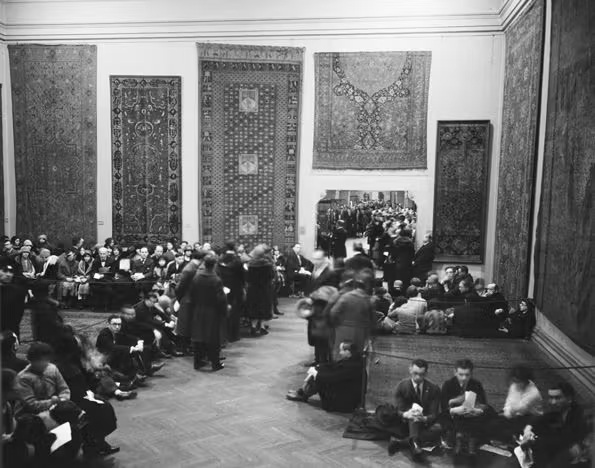
A symphonic concert attended by nearly 8,000 people in 1926, held amidst a remarkable display of Oriental carpets that adorned the gallery walls of the
Metropolitan Museum of Art.
.jpg)
Gallery E-14A, September 12, 1939. This photograph shows the first display of the 1354 mihrab from Isfahan, an artwork that served as the central symbol
of this section of the museum from 1939 to 1975 and remains one of its most iconic and distinguished objects today.
Persian Carpets: From the Home to the Museum
The story of the Metropolitan Museum, its Islamic art galleries, and the 1926 concert reminds us that Persian and Oriental handwoven carpets have always lived two lives at once. On the one hand, carpets belong in homes: beneath the feet of families, in reception rooms, and within the spaces of everyday life. On the other hand, the very same carpet can be mounted on the wall of a museum and appreciated as an artistic, historical, and cultural object.
These two dimensions do not diminish the value of the carpet; rather, they reveal its completeness. A handwoven carpet is both functional and artistic. It brings warmth to the home while carrying history. It belongs to contemporary life while remaining deeply rooted in the past.
This is precisely why Persian and Oriental carpets remain so beloved in modern interior design. A Sultanabad, Farahan, Kashan, Tabriz, or Heriz rug can sit beautifully alongside modern furniture, plain walls, and minimalist architecture, bringing depth, identity, and authenticity to the space. The same dialogue that appeared more than a century ago in the galleries of the Metropolitan Museum continues today in modern homes: a conversation between tradition and the contemporary world.
A review of the history of the Metropolitan Museum and its role in presenting Islamic art and Oriental carpets shows that carpets are a serious part of global art history. From the “Persian Room” of 1912 to the specialized galleries of Islamic art, from the 1910 exhibition of Oriental rugs to the 1926 concert held among historic carpets, all these events demonstrate that Persian and Oriental rugs have long held a place far beyond decoration.
For us at Gholizadeh Rugs, this history recalls an important truth: every authentic carpet is not merely a product; it is a narrative of culture, art, time, and human experience. A carpet laid today in a modern home can be a continuation of the same tradition that was once introduced as the living art of the East in the grand halls of museums, alongside classical music and before the eyes of thousands of visitors.
 English
  پارسی
پارسی